Prurigo pigmentosa induced by ketogenic
diet – a case report and literature review
Jing Hou 侯婧, Derek GC Ying 邢格政, Catherine XR Chen 陳曉瑞
HK Pract 2026;48:57-60
Summary
Prurigo pigmentosa (PP) is a rare inflammatory
recurrent dermatosis of unknown aetiology. With
the growing popularity of ketogenic diet in recent
years, there has been an emergence of reported PP
cases worldwide. We present a case of a 44-year-old
gentleman who developed an eruption of pruritic skin
rash three days after initiating ketogenic diet. The rash
characteristically progressed from symmetrical pruritic
erythematous papules over his chest, upper back and
abdomen, to reticulated hyperpigmentated lesions
within days of onset. After discontinuing the culprit
diet, the skin lesions resolved spontaneously without
any pharmacological treatment.
摘要
色素性瘙癢症是一種病因不明的罕見炎症性皮膚病。近年來,隨著生酮飲食的熱度越來越高,這種病例在全球多處被報道。這個案例報告會分享一個44歲男士在開始生酮飲食後三天出現了色素變性瘙癢症。皮疹的特徵性表現為對稱性瘙癢性丘疹,呈網狀分佈於胸部、上背部和腹部,然後轉變為網狀色素沉著過度病變。患者在停止生酮飲食,恢復正常飲食后,無需任何藥物治療,皮膚嚴重瘙癢迅速消失,皮疹也消退了。
Introduction
Prurigo pigmentosa (PP), a rare inflammatory
recurrent dermatosis, is characterised by pruritic papules
in a reticulate distribution, commonly appearing on the
chest, upper back and neck. These papules later evolve
into reticulated hyperpigmentation lesions. Although
the aetiology of PP remains to be confirmed, ketosis has
been identified as an important metabolic trigger.
With the increasing popularity of ketogenic diets in the last decade, there has been a corresponding rise in reported cases of PP worldwide. Ketogenic diet is a high-fat, adequate-protein, low-carbohydrate dietary regimen originally validated as a component of treatment for epilepsy, and is now gaining wide popularity for its use in weight control among the general population. Documented adverse effects of ketogenic diet include dyslipidaemia, constipation, hypoglycaemia, gouty attack, kidney stones and liver impairment.1 However, many individuals who undertake a ketogenic diet do not seek proper medical guidance or monitoring. This potentially leads to an underreporting and underdiagnosed of PP. In this paper, we presented a case of PP induced by ketogenic diet encountered in the primary care setting and would like to enhance all family physicians’ awareness of this rare but important side effect.
The Case presentation
History
Mr. Pang is a 44-year-old clerk, non-drinker and non-smoker. He enjoys good past health and is free of any allergies or family diseases. He presented to our clinic on 15/01/2024 complaining of a severe pruritic rash that has developed over the past week. Three days prior to his attendance, he had initiated a ketogenic diet and a vigorous exercise regimen for weight reduction. On the morning of the 4th day after his new diet, he noted an abrupt onset symmetrically distributed rash on both his chest. The itchiness progressively worsened with scattered rash rapidly spreading to his upper back, neck and abdomen, and coalescing into plaques with vesicles and mild hyperpigmentation. There was no pain, scaling or discharge. He denied having any fever or other systemic symptoms. He also denied any chemical contact, or intake of suspicious food items, over-the-counter medication or herbs prior to the eruption of these rashes. There was no drug or food allergy history before. He had not experienced similar rashes before, and his family and close contacts were well, without any similar dermatologic symptoms. He tried oral anti-histamine and topical steroid for three days, but the condition did not improve.
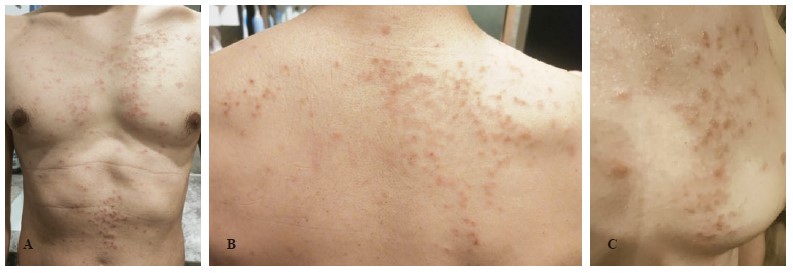
Figure 1. Symmetrical erythematous papules over chest and abdomen (A) and upper back (B), a few of papulovesicular
rashes with a background of reticulated hyperpigmentation (C)
Physical examination and surgical test
Physical examination showed that Mr. Pang was afebrile and his vital signs were stable. His general condition was satisfactory. His body mass index (BMI) was 25 kg/m2. Examination of his skin showed symmetrical erythematous papules on his chest, upper back and abdomen, with few papulovesicular lesions and a background of reticulated hyperpigmentation (Figure. 1 A-C). There was no tenderness, discharge or scaling over the rashes. The rest of his body, including his face, oral cavity, limbs, palms and soles were clear with no notable skin lesions or burrows. His small joints were normal with no signs of active arthritis or synovitis. Point of care tests revealed a normal blood glucose of 4.5 mmol/l but a strongly positive urine ketone test.
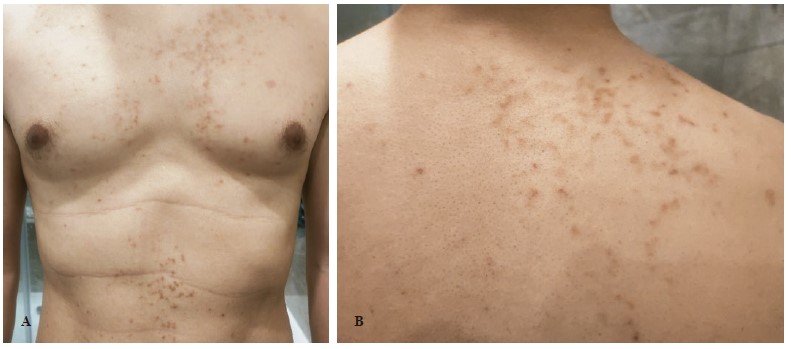
Figure 2. Post-inflammatory hyperpigmentation in a reticular pattern over the chest and abdomen(A) and upper back (B)
without scaling
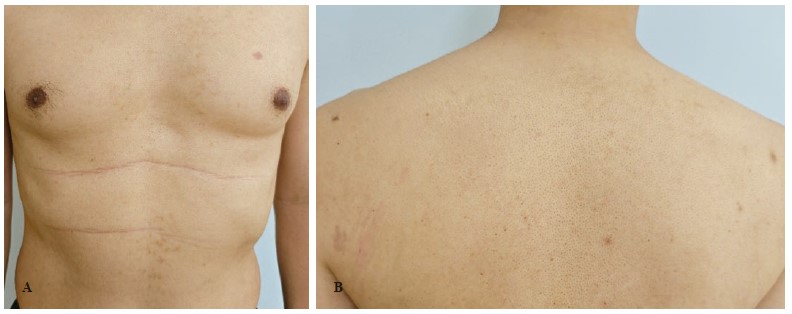
Figure 3. Clearance of hyperpigmented over the chest and abdomen(A) and upper back (B) at 6-month follow-up
Treatment and progress
Based on the history and clinical findings, a diagnosis of PP was made. Mr. Pang declined oral tetracyclines for treatment, but agreed to gradually increase his carbohydrates intake and resume a balanced diet. At 2-week follow-up, he reported that the pruritus had resolved within two days after ceasing his ketogenic diet, and the skin lesions completely dried up and become hyperpigmented within one week. On examination, post-inflammatory hyperpigmentation in a reticular pattern was observed over his chest, upper back and abdomen without scaling (Figure. 2 A-B). He was referred to our dietary services for weight maintenance advice.
At his 6-month follow-up, Mr. Pang reportedly exercised three times a week in a gym and his body weight remained the same. There was no recurrence of PP and the hyperpigmented lesions faded away spontaneous (Figure. 3 A-B).
Discussion
Prurigo pigmentosa (PP), as known as Nagashima disease, was first reported in Japan in 1971. For several decades, it was predominantly diagnosed in East Asia and among individuals of East Asian descents. More recently, it is often referred to as the “keto rash”, because of its association with ketogenic diet.2 With the growing popularity of ketogenic diet and the increased awareness of PP among clinicians, case reports and case series have emerged from more than 24 countries worldwide, involving a much more diverse range of ethnicities, including Asian, White, Hispanic and Black individuals, in descending order of frequency.3 The typical demographic characteristics were no longer East Asian female with an average age of 25.3, since cases with an increasing rate of male gender and a wider range of age and race have been observed.4
Although the aetiology of PP remains unclear, it is closely associated with states of ketosis, which can be triggered by a host of factors, such as ketogenic diet, prolonged fasting, diabetes, anorexia nervosa, bariatric surgery, and hyperemesis gravidarum.5 Consistent with our patient, the characteristic skin lesions of PP typically present as symmetrically distributed erythematous papules or patches with a reticulated pattern over back and chest, eventually evolving into reticulated hyperpigmentation. Some recent studies described atypical presentations of PP, including vesicular, bullous, and exfoliative rashes, as well as involvement of unusual sites, such as unilateral or segmental distributions, the midline, or the lower back.6,7,8
Differential diagnosis of PP includes urticaria, drug eruption, eczema, contact dermatitis, scabies and confluent and reticulated papillomatosis. Comorbidities such as diabetes, atopic dermatitis and adult-onset Still disease have also been reported in some cases.9 In a systematic review that included 307 cases of biopsy-confirmed PP, the histopathological findings included superficial perivascular inflammatory cell infiltrates, spongiosis and necrotic keratinocytes in the early stages, and the presence of melanophages, pigmentary incontinence and epidermal hyperplasia in the late stages.3 In our case, although no skin biopsy results were available, a history of diet change, typical presentation of rash, severe pruritus resistant to topical corticosteroid and oral antihistamine, and the presence of urine ketones were supportive of the diagnosis. Additionally, the rapid resolution after increasing the intake of carbohydrate serves as a diagnostic therapy. In clinical practice, the diagnosis of PP can be made clinically based on comprehensive history taking and physical examination.
Key messages
-
Prurigo pigmentosa (PP) is a rare inflammatory
recurrent dermatosis, but getting more common
nowadays following the increase popularity of
ketogenic diet in the general population.
-
PP is characterised by pruritic papules commonly
over the chest, upper back and neck area with
a net-like pattern, which later evolves into
reticulated hyperpigmentation lesions.
-
Oral tetracycline antibiotics (such as minocycline
and doxycycline) for 1-4 weeks is the first line
of treatment. Increase intake of carbohydrate
may further shorten the duration of treatment,
and even be an effective monotherapy for some
patients.
-
Being familiar with the metabolic triggers and
distinctive clinical pattern of PP is helpful for
family physicians in making an early diagnosis,
decreasing the significant distress caused by the
intensive pruritus, as well as helping to provide a
tailored effective treatment, and prevention of its
recurrence.
The first-line treatment for PP is oral tetracycline antibiotics (such as minocycline and doxycycline), rather than the more commonly prescribed topical corticosteroid and antihistamines.9 Other antibiotics including dapsone and erythromycin are also viable alternatives in treating PP. While the typical treatment duration ranges from one to four weeks, some patients may require longer therapy. The average resolution period is reported to be 34.5 days, with a recurrence rate of 10% within 20 months after treatment.3 In our patient, the entire course from the initiation of ketogenic diet to resolution of PP was less than 3 weeks, demonstrating a good prognosis with diet modification alone. For the residual hyperpigmentation, there is no known definitive treatment but it will fade with time as shown in our case.
In conclusion, this case highlighted the importance of recognising PP as a potential adverse effect of ketogenic diet, especially with the growing popularity of this dietary regimen in recent years. Prompt diagnosis and appropriate management, including discontinuation of the ketogenic diet and resumption of a balanced diet, can lead to the rapid resolution of the skin lesions without the need for pharmacological treatment. Increased awareness and early recognition of PP among family physicians can also help minimise the distress caused by the intense pruritus and prevent recurrence.
References
- Patikorn, C., Saidoung, P., Pham, T., et al. Effects of ketogenic diet on health outcomes: an umbrella review of meta-analyses of randomized clinical trials. BMC Med. 21, 196 (2023). https://doi.org/10.1186/s12916-023-02874-y
- Shahrigharahkoshan S, AlHalees Z, Pehr K. Ketogenic diet-induced prurigo pigmentosa: a rising association. Int J Dermatol. 2022 Jul;61(7):779-782. doi: 10.1111/ijd.15991. Epub 2021 Nov 26. PMID: 34826138.
- Mufti A, Mirali S, Abduelmula A, et al. Clinical manifestations and treatment outcomes in prurigo pigmentosa (Nagashima disease): A systematic review of the literature. JAAD Int. 2021 Apr 10; 3:79-87. doi: 10.1016/j.jdin.2021.03.003. PMID: 34409375; PMCID: PMC8362297.
- Shen A, Cheng CE, Malik R, et al. Prurigo pigmentosa: A multi-institutional retrospective study. J Am Acad Dermatol. 2023 Aug;89(2):376-378. doi: 10.1016/j.jaad.2023.03.034. Epub 2023 Mar 30. PMID: 37001731.
- Jazzar Y, Shadid AM, Beidas T, et al. Prurigo pigmentosa post-bariatric surgery: a case report. AME Case Rep 2023; 7:43.
- Altalhi ER, Azhari MS, Aljuhani SS, et al. Prurigo Pigmentosa: A Case Report With Unusual Presentation. Cureus. 2022 Dec 6;14(12): e32242. doi: 10.7759/cureus.32242. PMID: 36620814; PMCID: PMC9815784.
- Choi H, Kim CJ, Na CH, et al. A Case of Exfoliative Vesiculobullous Prurigo Pigmentosa Cured by Doxycycline and Topical Tacrolimus. Case Rep Dermatol. 2021 Sep 23;13(3):474-480. doi: 10.1159/000512708. PMID: 34720921; PMCID: PMC8525263.
- Yang J, Hu X, Niu M, et al. Prurigo Pigmentosa Successfully Treated with Oral Minocycline: A Case Report. Clin Cosmet Investig Dermatol. 2023 Apr 24; 16:1073-1077. doi: 10.2147/CCID.S404859. PMID: 37123623; PMCID: PMC10145459.
- Beutler BD, Cohen PR, Lee RA. Prurigo Pigmentosa: Literature Review. Am J Clin Dermatol. 2015 Dec;16(6):533-43. doi: 10.1007/s40257-015-0154-4. PMID: 26334426.
Jing Hou,
PhD (Public Health, CUHK), FHKAM (Family Medicine), FHKCFP, FRACGP
Resident,
Department of Family Medicine & Primary Healthcare, Kowloon Central Cluster,
Hospital Authority
Derek GC Ying,
LMCHK, FHKAM (Family Medicine), FHKCFP, FRACGP
Associate Consultant,
Department of Family Medicine & Primary Healthcare, Kowloon Central Cluster,
Hospital Authority
Catherine XR Chen,
PhD (Med, HKU), MRCP (UK), FRACGP, FHKAM (Family Medicine)
Consultant,
Department of Family Medicine & Primary Healthcare, Kowloon Central Cluster,
Hospital Authority
Correspondence to:
Dr. Hou Jing, Room 622, Nursing Quarter, Queen Elizabeth Hospital,
30 Gascoigne Road, Kowloon, Hong Kong SAR.
E-mail: hj791@ha.org.hk
|