
|
June 2026,Volume 48, No.2
|
Case Report
|
A case report on new-onset diabetes mellitus as an early sign of pancreatic cancer in an elderly patientVincent YY Lo 羅殷揚 HK Pract 2026;48:61-64 SummaryThis case report describes a 73-year-old woman with new-onset diabetes mellitus (NODM) presenting with epigastric pain and weight loss, subsequently diagnosed with pancreatic adenocarcinoma. Recent evidence demonstrates that NODM confers approximately a twofold increased risk of pancreatic cancer. Primary care physicians should maintain a heightened sense of clinical suspicion for pancreatic malignancy in older adults with NODM accompanied by alarm symptoms such as unexplained weight loss (≥5%), persistent epigastric pain, or rapid glycaemic deterioration. Multimodal imaging (contrast-enhanced computed tomography [CT], magnetic resonance cholangiopancreatography [MRCP], and positron emission tomography-CT [PET-CT]) enables accurate staging and resectability assessment. Multidisciplinary collaboration between primary care, endocrinology, and hepatobiliary surgery optimises early detection and patient outcomes.
摘要本病例報告描述一名73 歲女性因新發病型糖尿病(NODM)伴上腹部疼痛和體重下降而就診,隨後診斷為胰腺腺癌。近期證據表明,新發病型糖尿病(NODM) 可使罹患胰腺癌的風險增加約兩倍。家庭醫生對年長患者的NODM應保持警惕, 特別是當其伴有警示症狀例如:不明原因體重下降(≥5%)、持續性上腹部疼痛、血糖控制迅速惡化。有效的使用各種影像學檢查( 顯影電腦斷層掃描、磁振膽胰管造影和正電子放射-電腦斷層掃描) 可以協助胰腺腺癌的診斷、分期和切除可行性評估。家庭醫學、內分泌學和肝膽外科的多學科協作可有效地早期發現患者,並達至最理想的治療成果。 IntroductionPancreatic cancer is a highly lethal disease, often detected at advanced stages with approximately 50% of patients presenting with distant metastases at diagnosis.1 In Hong Kong, it ranks as the fourth leading cause of cancer death with 918 recorded deaths in 2023 ─ representing a 57.2% increase over the past decade.2 Population-based screening for pancreatic cancer lacks proven cost-effectiveness. However, selective surveillance in high-risk individuals, particularly those aged 50 years and above with new-onset diabetes mellitus (NODM), has demonstrated increasing diagnostic yield.3 This report describes a case of pancreatic cancer presenting as NODM and discusses clinical implications for primary care practice. The caseMs. Wong is a 73-year-old Chinese lady with a medical history of well-controlled hypothyroidism and hyperlipidaemia managed with thyroxine replacement and dietary modification. She maintained a healthy lifestyle without smoking or alcohol consumption. In August 2023, routine blood tests revealed NODM with glycated haemoglobin (HbA1c) of 12.5%, compared with 5.9% in June 2022, while the remaining laboratory parameters were unremarkable (Table 1). Table 1: Comparison of Laboratory Test Results
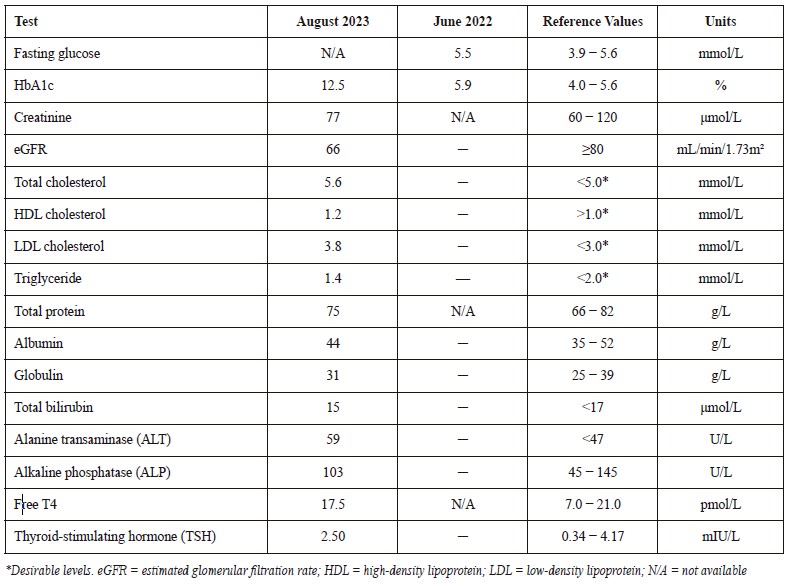
An early Family Medicine Clinic (FMC) followup was given where Ms. Wong was initiated on lowdose metformin. However, persistent hyperglycaemia prompted her to seek a private endocrinology consultation. Treatment was escalated to metformin extended-release and basal-bolus insulin therapy with continuous glucose monitoring. Despite medication adherence, her fasting glucose levels remained elevated at 9-13 mmol/ L. At the subsequent follow-up, Ms. Wong reported a three-month history of persistent epigastric pain accompanied by 5-kg weight loss and reduced appetite. Regarding family history, her mother died of colorectal cancer in her 60s and one of her brothers was diagnosed with hepatocellular carcinoma in his 50s. Physical examination revealed that she had a normotensive blood pressure (Blood Pressure 113/62 mmHg), normal body mass index (BMI) of 25.2 kg/ m2, and a vague epigastric mass with mild tenderness. Given the clinical suspicion of malignancy, Ms. Wong underwent PET-CT, which revealed a 3.7 x 2.98 x 2.71cm pancreatic head lesion with dilation of the main pancreatic duct (6.2mm), abutting major vessels supplying the pancreas without encasement. No distant metastases were identified. Subsequent MRI of the abdomen confirmed these findings. Following a specialist consultation in Taiwan, Ms. Wong underwent pancreaticoduodenectomy (Whipple’s procedure) in late 2023. Biopsy results confirmed moderately differentiated ductal adenocarcinoma of the pancreatic head involving the common bile duct with clear surgical margins and no lymph node involvement. Postoperatively Ms. Wong received adjuvant chemotherapy and continued insulin therapy. Remarkably, her HbA1c improved from 8.6% to 6.2% by May 2024. Association Between NODM and Pancreatic CancerEpidemiological evidenceEmerging evidence demonstrates a significant association between NODM and pancreatic cancer. Diabetes diagnosed within one year confers approximately a twofold relative risk for pancreatic cancer development.4 Individuals with diabetes duration of less than four years have a 50% greater risk compared with long-standing diabetes (> 4 years), with an odds ratio of 2.1 versus 1.5 (P=0.005).4 A recent meta-analysis of 36 cohort studies demonstrated that DM is associated with nearly double the pancreatic cancer risk (summary relative risk 1.94; 95% confidence interval [CI], 1.66-2.27), independent of geographic region, sex, study design, alcohol consumption, BMI and smoking status.5 The China Kadoorie Biobank study involving 0.5 million Chinese adults reported that DM is associated with almost a twofold higher risk of pancreatic cancer (adjusted hazard ratio 1.87, 95% CI 1.44-2.42), with excess risk highest in early years following diagnosis.6 Pathophysiological considerationsThe causal direction of the association between NODM and pancreatic cancer remains debated. Nearly half of pancreatic cancer patients have concurrent diabetes at diagnosis, and tumour removal frequently improves glycaemic control,7 suggesting cancer-induced paraneoplastic diabetes. Pancreatic cancer may trigger diabetes by releasing tumour-derived factors that disrupt glucose metabolism and β-cell function.8 Conversely, long-standing type 2 diabetes characterised by insulin resistance may promote pancreatic carcinogenesis through sustained hyperinsulinaemia and chronic inflammatory pathways.9 Clinical ImplicationsAlarm Symptoms Suggestive of Pancreatic CancerFamily physicians should maintain a heightened sense of clinical suspicion for pancreatic cancer in adults aged 50 years and above presenting with NODM, particularly when accompanied by the following features:
Imaging considerationsContrast-enhanced CT with pancreatic protocol remains the primary imaging modality, offering high accuracy of staging and resectability assessment of pancreatic cancer.12 Magnetic resonance cholangiopancreatography (MRCP) serves as an important adjunct imaging tool for patients with contraindications to contrast CT, iodine allergy, or equivocal findings on initial imaging.12 PET-CT with 18F-fluorodeoxyglucose detects occult distant metastatic disease (liver metastases, peritoneal carcinomatosis) that may be missed on conventional CT alone, with sensitivity of 80% for metastasis detection.13 Shared Decision-makingFamily physicians play a crucial role in facilitating informed patient discussions regarding diagnostic imaging. Discussions should address both benefits ─ including early detection enabling potentially curative surgery, improved survival for early-stage disease, timely multidisciplinary care ─ and limitations, including radiation exposure, financial costs, nonspecific findings, incidental discoveries, and associated patient anxiety. Key messages
Multidisciplinary ApproachEffective management of patients with NODM and suspected pancreatic cancer requires coordinated multidisciplinary care: Early referral to endocrinology is indicated for:
Urgent referral for hepatobiliary surgery is warranted when:
Multidisciplinary team discussions facilitate accurate diagnosis, appropriate staging, and coordinated treatment planning, ultimately improving patient outcomes. ConclusionNew-onset diabetes mellitus in older adults represents a potential early marker of pancreatic cancer. Family physicians should maintain a heightened sense of vigilance when NODM is accompanied by red flag symptoms. Facilitating informed patient discussions about diagnostic imaging and ensuring timely multidisciplinary referral are essential components of optimal primary care management. Early detection through systemic clinical assessment and coordinated specialist involvement can substantially improve outcomes for this challenging malignancy. References
Vincent YY Lo,
MBBS (Sydney, Australia), MCHK, MRCP, MPH
Correspondence to:
Central Office, Department of FM &PHC, 6/F, Tsan Yuk Hospital,
30 Hospital Road, Sai Ying Pun, Hong Kong SAR.
|
|