
What’s in the web for family physicians -
Food-drug and herb-drug interactions:
mechanisms, clinical risks, and management
in the Hong Kong context
Sio-pan Chan 陳少斌,Alfred KY Tang 鄧權恩
Introduction:
The concurrent use of conventional pharmaceuticals
with herbal medicines and dietary supplements is a
deeply ingrained practice in Hong Kong, representing a
significant public health concern. Local epidemiological
data underscores the scale of this issue: a 2024 cross-sectional
study of patients with chronic diseases
attending public specialist out-patient clinics in
Hong Kong found that 46.6% reported using herbal
supplements, with usage highest among patients with
rheumatological conditions (62.3%), followed by those
with neurological (52.0%) and dermatological (48.1%)
diseases (Chan et al., 2024). This high prevalence of
concomitant use creates a substantial interface for
potential adverse interactions.
The risk is amplified by a critical communication
gap between patients and healthcare providers. The same
study revealed that 61.4% of patients did not report
their traditional Chinese medicine (TCM) use to their
physician, most commonly because they were not asked
(38.1%) or believed the physician did not need to know
or would not understand (22.5%). This lack of disclosure
prevents clinicians from identifying and managing
potential interactions, leaving patients vulnerable.
The scientific basis for concern is robust.
Pharmacological screening indicates that a majority of
commonly used TCM herbs can interact with conventional drug pathways. For example, a study investigating
the in vitro effects of 50 common TCM herbs found
that over 60% exhibited inhibition of key cytochrome
P450 (CYP450) enzymes, the primary system for drug
metabolism in the body (Li & Zhang, 2023). This mirrors
a global pattern where herb - drug interactions (HDIs)
are recognised as a documented cause of clinical adverse
events, ranging from therapeutic failure to serious toxicity
(World Health Organization, 2022).
The situation in Hong Kong - characterised
by high usage, demonstrable pharmacological
interaction potential, and significant patient - provider
communication barriers - highlights an urgent need
for enhanced awareness, systematic assessment, and
integrated management strategies.
Core Mechanisms of Interactions
- Schenone C, Cohen D. Drug–food interactions: Mechanisms, clinical relevance, and management. Pharmaceuticals (Basel). 2021;14(4):322. doi:10.3390/ph14040322
- Izzo AA, Ernst E. Interactions between herbal medicines and prescribed drugs: an updated systematic review. Drugs. 2009;69(13):1777–1798. doi:10.2165/11317010-000000000-00000
- Boullata JI, Carrera AL, Harvey L, et al. ASPEN Safe Practices for Enteral Nutrition Therapy. JPEN J Parenter Enteral Nutr. 2017;41(1):15–103. doi:10.1177/0148607116680379
Interactions between dietary components, herbal
products, and pharmaceutical drugs occur through
pharmacokinetic (affecting the drug’s concentration in
the body) and pharmacodynamic (affecting the drug’s
action) pathways.
-
Pharmacokinetic Interactions: These alter how
the body absorbs, distributes, metabolizes, or
excretes a drug.
-
Enzyme Inhibition: A substance decreases
the activity of metabolic enzymes (e.g.,
CYP450), slowing drug breakdown and
potentially leading to accumulation and
toxicity (e.g., grapefruit juice).1
-
Enzyme Induction: A substance increases
enzyme activity, accelerating drug
metabolism and reducing blood levels,
which may result in therapeutic failure (e.g.,
St. John’s wort).2
-
Altered Absorption: Food or herbs can bind
to drugs or affect gastrointestinal motility,
thereby changing the amount of drug that
enters systemic circulation (e.g., dairy
products reducing absorption of tetracycline
antibiotics).1,3
-
Pharmacodynamic Interactions: These occur
when two substances exert additive, synergistic,
or opposing effects on the same physiological
target or pathway, independent of changes in drug concentration (e.g., concurrent use of
warfarin and ginkgo biloba increasing bleeding
risk).2
Common Food-Drug Interactions
- Bailey DG, Dresser G, Arnold JM. Grapefruit-medication interactions: forbidden fruit or avoidable consequences? CMAJ. 2013;185(4):309–316. doi:10.1503/cmaj.120951
- Schmidt LE, Dalhoff K. Food–drug interactions: mechanisms and clinical implications. Drugs. 2023;83(12):1095–1117. doi:10.1007/s40265-023-01912-8
- Izzo AA, Di Carlo G, Borrelli F, et al. Cardiovascular pharmacokinetic and pharmacodynamic herb–drug interactions: a systematic review. Phytomedicine. 2022;104:154283. doi:10.1016/j.phymed.2022.154283
- Boullata JI, Carrera AL, Harvey L, et al. ASPEN Safe Practices for Enteral Nutrition Therapy. JPEN J Parenter Enteral Nutr. 2017;41(1):15–103. doi:10.1177/0148607116680379
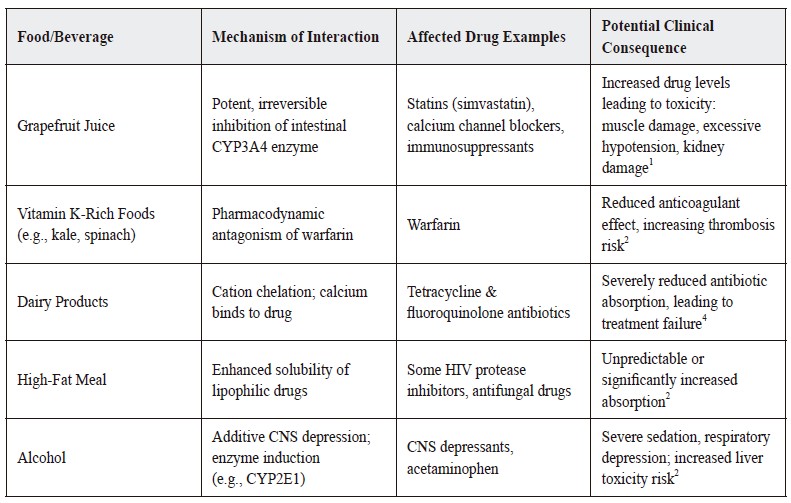
Food can drastically alter a drug's bioavailability.
Key examples are summarised below.
Table 1: Common and Clinically Significant Food-Drug Interactions
High-Risk Herb-Drug Interactions
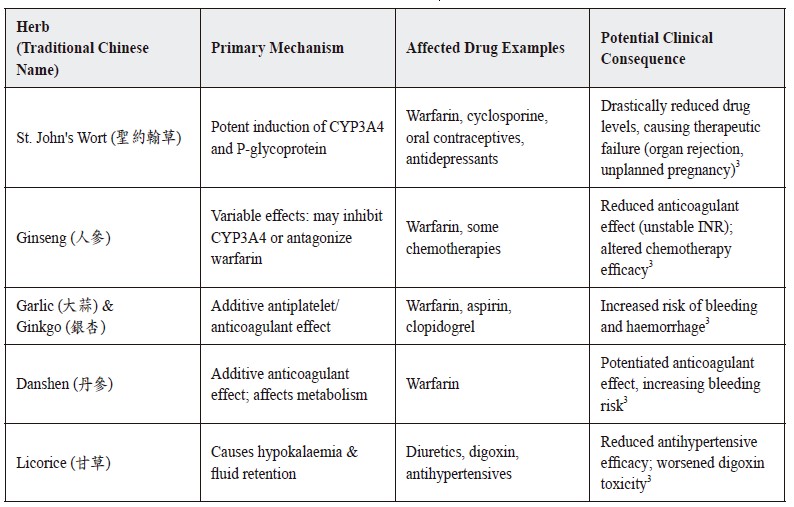
The multi-constituent nature of herbs creates complex interaction risks, particularly relevant in Hong Kong's
context of high TCM use.
Table 2: Common and Clinically Significant Herb-Drug Interactions
Prevention and Management Strategies
- Wong MCS, Leung MCY, Tsang CSL, et al. Integrating traditional Chinese medicine into primary care in Hong Kong: a cross-sectional survey of public attitudes and provider practices. BMC Complement Med Ther. 2021;21:178. doi:10.1186/s12906-021-03338-5
- Chan EW, Chui CS, Wong ICK, et al. Concurrent use of Chinese herbal medicines and Western drugs in the general population: a systematic review of prevalence and safety concerns. Pharmacoepidemiol Drug Saf. 2020;29(10):1223–1234. doi:10.1002/pds.5068
- Lam AYK, Cheng KKF, Wong ICK. Public awareness and behaviors regarding potential interactions between Chinese herbal medicines and prescribed drugs in Hong Kong. J Altern Complement Med. 2019;25(10):1008–1015. doi:10.1089/acm.2019.0121
Mitigating risks requires proactive, systematic
approaches tailored to address the identified barriers in
Hong Kong.
For Healthcare Providers:
-
Routine, Non-Judgmental Inquiry: Systematically
ask every patient about all prescription drugs, over-the-counter medicines, and herbal supplements
using open-ended questions to encourage honest
disclosure.1
-
Cultivate Cultural Competence: Acknowledge
the cultural value of Traditional Chinese
Medicine (TCM) to build trust and facilitate
open dialogue about concurrent use of herbs and
pharmaceuticals.1,2
-
Utilise Professional Resources: Consult evidence-based,
locally relevant resources that include herb-drug
interaction data, especially for commonly used
TCM products in Hong Kong.2
-
Provide Clear, Specific Instructions: Give written,
actionable advice (e.g., “Avoid grapefruit entirely,”
“Take this antibiotic 2 hours apart from dairy”) to
improve adherence and reduce ambiguity.3
-
Enhanced Monitoring: Implement more frequent
therapeutic monitoring (e.g., INR for warfarin
users taking Danshen or ginseng) when high-risk
combinations are identified.2
For Patients and the Public:
-
Prioritise Full Disclosure: Always inform
all healthcare providers - including doctors,
pharmacists, and TCM practitioners - about
everything you are taking, including herbs,
supplements, and dietary habits.1,3
-
Adhere to Instructions: Follow “take with food” or
“take on empty stomach” directions on medication
labels to optimise efficacy and avoid absorption-related
interactions.3
-
Adopt the “Ask” Habit: When prescribed a
new drug, proactively ask: “Should I take this
with food?” and “Are there any foods, herbs, or
supplements I should avoid?”.3
-
Understand “Natural” Does Not Mean “Safe”: Recognise that herbal products contain
pharmacologically active compounds that can
interact with medications just as strongly as
conventional drugs.2
Conclusion
Food-drug and herb-drug interactions represent a
pervasive, clinically significant, and often preventable
challenge, particularly in populations like Hong Kong
with high rates of herbal medicine use. The mechanisms
- primarily modulation of metabolic enzymes and direct
pharmacodynamic effects - can lead to consequences
ranging from therapeutic failure to life-threatening
toxicity. The high rate of patient non-disclosure presents
a major obstacle to effective clinical management.1
Effective risk mitigation hinges on overcoming
communication barriers through culturally sensitive,
routine inquiry and patient education. Future efforts
should focus on integrating validated herb-drug
interaction data into local clinical decision support
systems, enhancing relevant pharmacology in healthcare
curricula, and promoting interdisciplinary collaboration
between conventional and TCM practitioners. By
adopting a vigilant, informed, and patient-centered
approach, healthcare professionals in Hong Kong and
similar contexts can significantly reduce these risks and
optimise therapeutic outcomes for all patients.
Sio-pan Chan,
MBBS (HK), DFM (HKCU), FHKFP, FHKAM (Family Medicine)
Family Physician in private practice
Alfred KY Tang,
MBBS (HK), MFM (Monash)
Family Physician in private practice
Correspondence to:
Dr. Sio-pan Chan, SureCare Medical Centre (CWB), Room 1116-7,
11/F, East Point Centre, 555 Hennessy Road, Causeway Bay,
Hong Kong SAR.
E-mail: siopanc@gmail.com
|